
Most RO plants in Pakistan use one of two commercial membrane sizes: the 4040, which makes about 9,000 litres a day, and the 8040, which makes roughly four times that. In October 2026 one Pakistani supplier listed a 4040 at Rs 39,900 and an 8040 at Rs 112,000. The cheapest way to make either one last is to look after the filters in front of it.
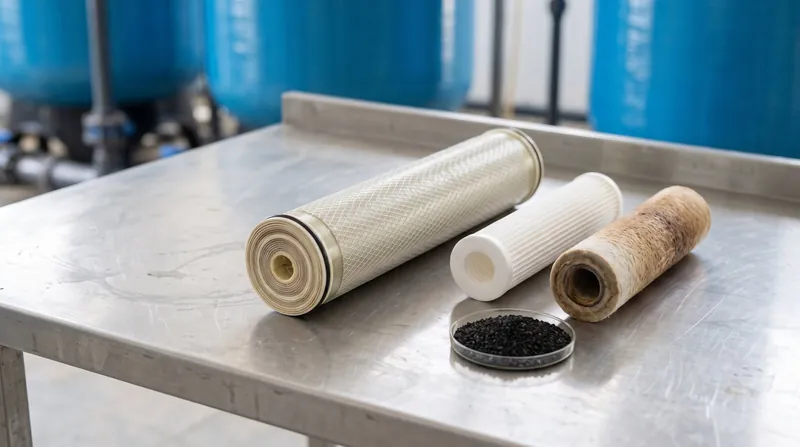
The membrane is the most expensive part you'll replace, and the one that decides your TDS. This guide covers the sizes and prices, the filters and chemicals that protect a membrane, and the signs that it needs cleaning or replacing.
The size code tells you the membrane's dimensions
A 4040 membrane is 4 inches across and 40 inches long. An 8040 is 8 inches across and 40 inches long. Home units use much smaller membranes, usually sold by how many gallons a day (GPD) they make.
| Membrane | Used in | Rated output | Price seen in Pakistan |
|---|---|---|---|
| Home membrane (e.g. 100 GPD) | Under-sink and home RO units | About 380 litres a day | Ask your supplier |
| 4040 brackish water | Small commercial plants | 2,400 GPD, about 9,100 litres a day | Rs 39,900 (Vontron LP21-4040) |
| 8040 brackish water | Larger plants | 10,500 GPD, about 39,700 litres a day | Rs 112,000 (Vontron LP22-8040) |
| 8040 seawater | Very salty water | 9,000 GPD | Rs 195,000 (Vontron SW8040LE-400) |
Rated output is measured under the maker's test conditions. DuPont tests its BW30-4040 with 2,000 ppm salt water at 225 psi and 25 °C, and says an individual element can vary by ±20%. Cold water, low pressure or salty feed water all mean less output in your plant.
Sources: Kamadi.pk, Industrial RO membranes (prices checked 30 Oct 2026); DuPont, FilmTec BW30-4040 and BW30-2540 product data sheet.
Brackish water membranes are made for tube-well water
Brackish water (BW) membranes are made for groundwater and tube-well water. Seawater (SW) membranes handle much saltier water at higher pressure, and cost more, as the table shows. Use the one your source water needs. A lab test of your feed water settles it.
Filters before the membrane do most of the protecting
An RO membrane is tough on salts and fragile against almost everything else. The filters in front of it are cheap insurance:
- Sediment or multimedia filter: catches sand, silt and rust. DuPont sets a maximum silt density index (SDI) of 5 for feed water.
- Activated carbon: removes chlorine. DuPont's membranes tolerate less than 0.1 ppm free chlorine.
- Micron cartridge filter: a fine last guard just before the high-pressure pump.
Chlorine damage can't be undone. Dow's troubleshooting guide says oxidised or mechanically damaged elements "cannot be restored" and need replacing. In Punjab, bottled water units also have to change filters every month under PFA rules, with records and video uploaded to the PFA portal.
Sources: DuPont, FilmTec BW30-4040 and BW30-2540 product data sheet; Dow Water & Process Solutions (2012), Troubleshooting of FilmTec membrane plants; APP (18 Nov 2025), PFA issues new SOPs for commercial water filtration plants.
Antiscalant stops scale crusting onto the membrane
As water passes through, the salts left behind get more and more concentrated on the reject side. Calcium and other minerals can then come out of solution and form scale on the membrane surface, cutting output and raising TDS.
Antiscalant is a chemical dosed into the feed water before the membrane to stop that happening. Some plants use a softener in front of the RO instead, or as well. We don't sell antiscalant. Ask your plant supplier for one that suits your membrane and water.
A dosing pump does two different jobs in one plant
A dosing pump, or metering pump, adds a small, steady amount of solution into a pipe. Most RO plants need two of them, kept completely separate:
| Where | What it adds | Why |
|---|---|---|
| Before the membrane | Antiscalant | Protects the membrane from scale |
| After the membrane | Mineral solution: calcium chloride, magnesium sulphate, sodium bicarbonate | Puts back taste, hardness and alkalinity |
Never add minerals before the membrane. The membrane would reject most of them, and the extra calcium makes scaling worse. Our remineralisation guide explains how to set up the after-membrane dosing.
Minerals for your dosing tank
Food-grade calcium chloride, magnesium sulphate and sodium bicarbonate at Rs 800 per kg, with certificates you can check. Same-day delivery in Lahore, 2–3 days across Pakistan.
Three readings show when a membrane needs cleaning or replacing
Dow's FilmTec troubleshooting guide lists the symptoms to watch: falling product flow, rising salt passage (your product TDS creeps up) and a rising pressure drop across the membranes. It also warns that "if cleaning is delayed, it becomes increasingly difficult to remove foulants".
So log these every day, at the same time:
- Feed and product TDS, and the rejection % worked out from them. Our TDS meter guide has the formula and a worked example.
- Pressure before and after the membranes.
- Product flow, from the flow meter or by timing how long a tank takes to fill.
Compare with the readings from when the membrane was new. Cleaning can bring a fouled membrane back. A membrane damaged by chlorine, or one that stays poor after cleaning, needs replacing.
There's no fixed lifespan. DuPont's data sheets don't give one, because it depends so much on your water and how well the pre-treatment is kept up. For small home units, the US EPA's WaterSense label requires a membrane to last at least a year before it needs replacing.
Sources: Dow Water & Process Solutions (2012), Troubleshooting of FilmTec membrane plants; US EPA WaterSense, Point-of-use reverse osmosis systems.
New membranes need a careful start
- Throw away the first hour of water. DuPont says permeate from the first hour of operation should be discarded.
- Keep it wet. Once a membrane has been wetted, it should stay moist. For long shutdowns, DuPont says to keep elements in a preservative solution to stop biological growth.
- Don't push back. DuPont warns against back-pressure on the product side, which can damage the element.
Source: DuPont, FilmTec BW30-4040 and BW30-2540 product data sheet.
New to RO? Start with how an RO plant works, step by step, or see what a plant costs to set up and run.
Frequently asked questions
What is the RO membrane price in Pakistan?
One Pakistani supplier listed a Vontron 4040 brackish water membrane at Rs 39,900 and an 8040 at Rs 112,000 in October 2026. A seawater 8040 was Rs 195,000. Prices vary by brand and supplier.
How long does an RO membrane last?
There's no fixed lifespan, because it depends on your water and how well the filters in front of it are maintained. For small home units, the US EPA's WaterSense label requires the membrane to last at least a year.
What is the difference between a 4040 and an 8040 membrane?
Size and output. A 4040 is 4 inches by 40 inches and makes about 2,400 gallons (9,100 litres) a day. An 8040 is 8 inches by 40 inches and makes roughly four times as much.
What is antiscalant used for in an RO plant?
It's dosed into the feed water before the membrane to stop calcium and other salts forming scale on the membrane as they get concentrated.
Can I add minerals before the RO membrane?
No. The membrane would reject most of them, and extra calcium increases scaling. Add minerals after the membrane, with a separate dosing pump.
How often should RO plant filters be changed?
Bottled water units in Punjab must change filters every month under Punjab Food Authority rules, and keep records and video on the PFA portal. Check your pressure readings too: a filter clogs faster on dirty water.
Sources
- Kamadi.pk, Industrial RO membranes (prices checked 30 Oct 2026)
- DuPont, FilmTec BW30-4040 and BW30-2540 product data sheet
- Dow Water & Process Solutions (2012), Troubleshooting of FilmTec membrane plants
- US EPA WaterSense, Point-of-use reverse osmosis systems
- APP (18 Nov 2025), PFA issues new SOPs for commercial water filtration plants
Related: What is an RO plant? · TDS meter price in Pakistan · RO water remineralisation guide · Our minerals and prices