
An RO plant pushes water at high pressure through a membrane so fine that most dissolved salts can't get through. Out come two streams: low-TDS product water, called permeate, and a salty reject stream, called concentrate. Every other part of the plant is there to protect that membrane, or to fix the water after it.
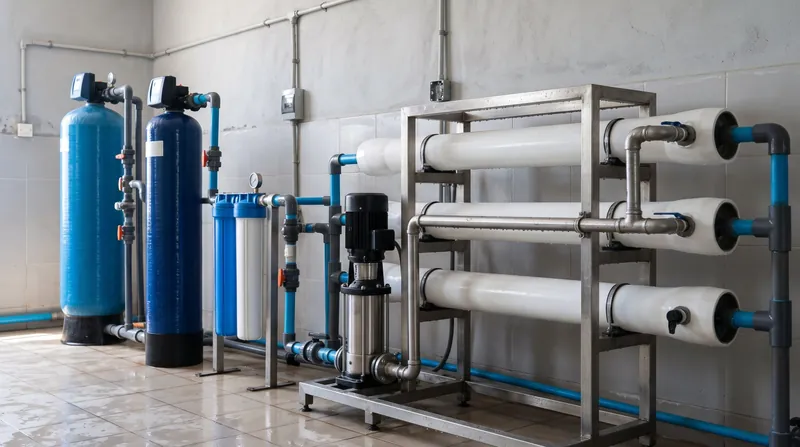
RO stands for reverse osmosis. In Pakistan most people call an RO water plant a "filtration plant", and many of the plants on our streets are RO plants. Here's how one works, stage by stage, in plain words.
Reverse osmosis runs osmosis backwards, using pressure
Osmosis happens on its own. Put fresh water and salty water on either side of a membrane that lets water through but holds salts back, and water moves towards the salty side to even things out.
Reverse osmosis pushes the other way. A pump puts the salty side under enough pressure to overcome that natural pull, so water is squeezed out through the membrane and the salts stay behind. The US EPA describes it simply: "RO is the process by which pressure forces water through a semi-permeable membrane."
It works well. DuPont's BW30 membranes are rated at 99.5% salt rejection under its standard test (2,000 ppm salt water at 225 psi and 25 °C). Real plants vary with water, pressure and temperature, but most dissolved salts stay out.
Sources: US EPA WaterSense, Point-of-use reverse osmosis systems; DuPont, FilmTec BW30-4040 and BW30-2540 product data sheet.
The stages of an RO plant, in order
Here's the path water takes through a typical commercial RO plant:
Raw water tank → Sediment / multimedia filter → Activated carbon → Antiscalant + micron cartridge → High-pressure pump → RO membranes → Minerals added back → Disinfection (UV) → Storage and filling
| Stage | What it does | Why it matters |
|---|---|---|
| 1. Sediment or multimedia filter | Catches sand, silt and rust | Particles clog membranes. DuPont sets a maximum silt density index (SDI) of 5 for feed water. |
| 2. Activated carbon | Removes chlorine and some organics | Membranes tolerate less than 0.1 ppm free chlorine. More than that damages them for good. |
| 3. Antiscalant and micron cartridge | A chemical that stops scale forming, then a fine cartridge filter as a last guard | As water passes, salts get concentrated on the reject side and can crust onto the membrane. |
| 4. High-pressure pump | Raises the pressure to push water through | The BW30-4040 is tested at 225 psi and rated up to 600 psi. |
| 5. RO membranes | Separate water from dissolved salts | This is where TDS drops. |
| 6. Remineralisation | Measured minerals are dosed back into the product water | RO water is low in minerals, tastes flat and can be corrosive. |
| 7. Disinfection, storage and filling | UV or ozone, then clean tanks and bottles | Germs can get in after the membrane, through tanks, pipes and handling. |
Not every plant has every stage. Some add a softener before the RO, and small plants may use cartridges in place of a multimedia vessel. Our RO membrane and filters guide goes deeper into stages 1 to 5.
Source: DuPont, FilmTec BW30-4040 and BW30-2540 product data sheet.
The salts don't disappear: they leave in the reject water
RO doesn't destroy anything. Whatever the membrane holds back leaves the plant in the concentrate, so every RO plant has a drain.
How much water goes to drain depends on the design. The US EPA says a typical small home RO unit sends five gallons or more to drain for every gallon of treated water, and its efficient WaterSense units must stay at 2.3 gallons or less. Commercial plants run several membranes in a row to recover a bigger share, but none of them gets every litre back.
Source: US EPA WaterSense, Point-of-use reverse osmosis systems.
RO removes the good minerals too, so plants add them back
A membrane can't pick and choose. Lenntech says reverse osmosis "is not a selective ion removal process", so calcium and magnesium leave along with the salts you wanted gone.
There's one thing it lets through. Hydranautics, a membrane maker, notes that carbon dioxide "is not rejected or concentrated by a RO membrane". With the bicarbonate gone and the carbon dioxide still there, RO water often comes out slightly acidic. WHO describes this kind of water as "low in minerals" and "poorly buffered".
That's why many plants add a measured dose of calcium chloride, magnesium sulphate and sodium bicarbonate after the membrane. Our remineralisation guide shows how much each gram adds.
Sources: Lenntech, Remineralization; Hydranautics, RO Water Chemistry (technical paper); WHO (2011), Safe drinking-water from desalination.
Minerals for after the membrane
Food-grade calcium chloride, magnesium sulphate and sodium bicarbonate from Minerals by Mr. RO, Rs 800 per kg with certificates. Delivered across Pakistan.
RO plant, filtration plant and softener do different jobs
| System | Removes | Doesn't remove |
|---|---|---|
| Basic filtration (sediment, carbon, UV) | Particles, chlorine taste and smell; UV kills germs | Dissolved salts. TDS stays the same. |
| Water softener | Calcium and magnesium (swapped for sodium) | Overall TDS. Salty water stays salty. |
| RO plant | Most dissolved salts, including hardness | Dissolved gases like carbon dioxide |
So if your water is hard but not salty, a softener may be all you need. If it's salty or the TDS is high, you need RO. Our guide to sodium, calcium and magnesium in water treatment explains how softeners work.
Check that your plant is working with four readings
- Feed and product TDS. Work out rejection: (feed − product) ÷ feed × 100. A steady drop means the membrane needs attention. Our TDS meter guide shows how to take a reliable reading.
- Pressure gauges. Note the pressure before and after the membranes every day. A rising difference often means fouling.
- Product flow. Less water at the same pressure points the same way.
- Lab tests. A low TDS says nothing about germs. In September 2026 the Punjab Food Authority shut nine filtration plants in Lahore after lab tests found harmful bacteria.
Source: APP (28 Sept 2026), PFA shuts nine water filtration plants over bacterial contamination.
Thinking of setting up your own? See what a water filtration plant costs in Pakistan.
Frequently asked questions
What is an RO plant?
A water treatment plant that uses reverse osmosis: a high-pressure pump pushes water through a membrane that holds back most dissolved salts. It produces low-TDS product water and a salty reject stream.
What is the full form of RO?
Reverse osmosis. Pressure is used to push water through a semi-permeable membrane, the opposite direction to natural osmosis.
Does an RO plant remove bacteria?
RO membranes can hold back bacteria, but plants still disinfect, usually with UV, because germs can enter after the membrane through tanks, pipes and handling. A monthly lab test is the only way to know.
How much water does an RO plant waste?
It depends on the design. The US EPA says typical small home RO units send five gallons or more to drain for every gallon of treated water. Commercial plants recover more, but every RO plant has some reject water.
Why is RO water TDS so low?
Because the membrane holds back most dissolved salts. DuPont rates its BW30 membranes at 99.5% salt rejection under test conditions. That's why many plants add some minerals back afterwards.
What is the difference between an RO plant and a filtration plant?
A basic filtration plant (sediment, carbon, UV) removes particles, chlorine and germs, but not dissolved salts. An RO plant also removes most dissolved salts, so it lowers TDS. In Pakistan, many plants called filtration plants are RO plants.
Sources
- US EPA WaterSense, Point-of-use reverse osmosis systems
- DuPont, FilmTec BW30-4040 and BW30-2540 product data sheet
- Hydranautics, RO Water Chemistry (technical paper)
- Lenntech, Remineralization
- WHO (2011), Safe drinking-water from desalination
- APP (28 Sept 2026), PFA shuts nine water filtration plants over bacterial contamination
Related: RO membrane and filters guide · Water filtration plant price in Pakistan · RO water remineralisation guide · Our minerals and prices