
Remineralisation just means putting some minerals back into water after it comes out of the RO. RO takes out almost everything dissolved in the water. What's left tastes flat and can slowly eat into pipes and fittings. So many plants add a small, measured amount of calcium, magnesium and bicarbonate back before the water is stored and bottled.
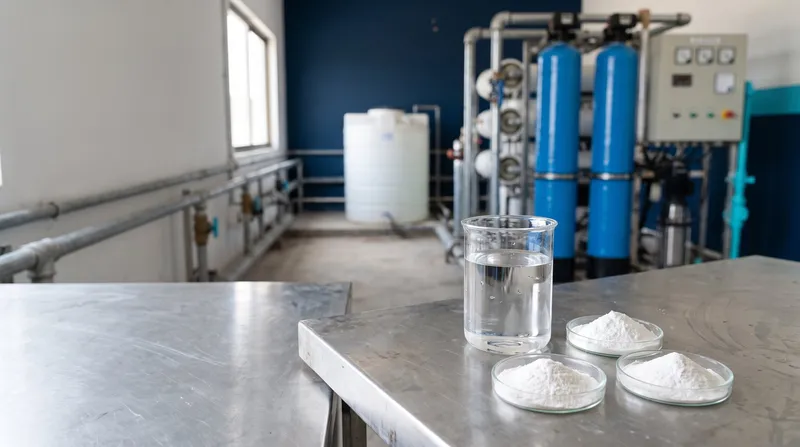
Below we explain why, what each mineral does, and how to keep a check on it. Every fact links to where it comes from, so you can read more if you want.
What does RO actually take out?
An RO membrane holds back most of the salts and minerals in water. It can't choose which ones. Lenntech, a water treatment company, says it plainly: reverse osmosis "is not a selective ion removal process". So calcium and magnesium go out along with the things you wanted to remove.
There is one thing it lets through. Carbon dioxide is a gas, and Hydranautics, an RO membrane maker, notes that it "is not rejected or concentrated by a RO membrane". That's why RO water often comes out with a lower pH than the water that went in. If you want the full picture, see how an RO plant works, step by step.
The World Health Organization (WHO) describes water like this as "low in minerals" and "poorly buffered". In simple words, it has very little in it to hold the pH steady.
Sources: Lenntech, Remineralization; Hydranautics, RO Water Chemistry; WHO, Safe drinking-water from desalination (2011).
Why put minerals back?
1. Taste. WHO says water with very low dissolved solids can be unacceptable "because of its flat, insipid taste".
2. Pipes, tanks and fittings. The same WHO document says such water "is also often corrosive to water-supply systems". WHO's guide on desalinated water says it must be "stabilized to minimize its corrosive effect on pipes and fittings", often by remineralising it.
3. Lower TDS isn't automatically better. In September 2026 the director of PCRWR's National Water Quality Laboratory told APP that people often think very low TDS means safer, better water, and that "this is not correct". She also said bottled water producers commonly use RO and may then add selected minerals back.
Sources: WHO, Total dissolved solids in drinking-water; WHO, Safe drinking-water from desalination; APP, "Ultra-low TDS water may not mean healthier water: PCRWR expert".
Which minerals do plants add?
WHO's desalination guide talks about remineralising with calcium and magnesium salts, or by running water through limestone. One of the recipes Lenntech lists is calcium chloride with sodium bicarbonate. These are the three salts we supply, and what each one does:
| Mineral | What it puts in the water | Why it's used |
|---|---|---|
| Calcium chloride CaCl₂·2H₂O | Calcium and chloride | Adds calcium. Calcium and magnesium together make up water hardness. |
| Magnesium sulphate MgSO₄·7H₂O | Magnesium and sulphate | Adds magnesium, the other part of hardness. |
| Sodium bicarbonate NaHCO₃ | Sodium and bicarbonate | Bicarbonate is alkalinity. It's what helps water hold its pH steady. |
Why does hardness matter here? Health Canada says hard water is "generally less corrosive than soft water". That's a big part of why calcium and magnesium go back in.
Two different sodium salts, two different jobs. Sodium chloride is softener salt. It cleans the softener resin before the RO and is not added to drinking water. Sodium bicarbonate is added after the RO to bring back alkalinity.
Sources: WHO, Safe drinking-water from desalination; Lenntech, Remineralization; Health Canada, Calcium, magnesium and hardness.
How much does one gram add?
This is the part most people find confusing, so here it is plainly. If you dissolve 1 gram in 1,000 litres, you add 1 mg/L of that salt. But only part of that salt is the mineral you want. We worked these out from the chemical formulas:
| 1 gram in 1,000 litres of… | Adds about |
|---|---|
| Calcium chloride (dihydrate) | 0.27 mg/L calcium and 0.48 mg/L chloride |
| Magnesium sulphate (heptahydrate) | 0.10 mg/L magnesium and 0.39 mg/L sulphate |
| Sodium bicarbonate | 0.27 mg/L sodium and 0.73 mg/L bicarbonate |
So magnesium sulphate is mostly water and sulphate. To add just 1 mg/L of magnesium to 1,000 litres, you need about 10 grams of it. For calcium you need about 3.7 grams of calcium chloride per 1 mg/L. Your actual product is a little less than 100% pure, so check the purity on its certificate too.
How much should you add?
There's no single number for everyone. WHO's desalination guide does not set a fixed calcium or magnesium level and says the best levels still need to be worked out.
One useful reference: Health Canada says a hardness of 80 to 100 mg/L (as calcium carbonate) "provides an acceptable balance between corrosion and incrustation". Incrustation just means scale building up.
You also don't want to add so much that people can taste it. WHO says people start to taste calcium chloride at around 200 to 300 mg/L, and magnesium sulphate at around 400 to 600 mg/L. If your water suddenly tastes salty or odd after dosing, check your weighing first.
Sources: WHO, Safe drinking-water from desalination; Health Canada, Calcium, magnesium and hardness; WHO, Chloride in drinking-water; WHO, Sulfate in drinking-water.
Want a starting mix for your plant?
Send us your plant capacity and your latest water report on WhatsApp, and we’ll suggest which minerals to start with.
Ways to remineralise
| Method | How it works |
|---|---|
| Adding mineral salts | Measured amounts of calcium and magnesium salts (and sodium bicarbonate) are dissolved and added to the RO water. |
| Limestone (calcite) | Water runs through a bed of limestone that slowly dissolves into it. |
| Lime | Lime is added to the water. WHO notes it can make water a bit cloudy. |
All three are mentioned in WHO's desalination guide. Adding salts is the only one of the three where you can control calcium, magnesium and alkalinity separately.
Setting it up at your plant
The basic steps are the same ones we give on our product pages:
- Weigh the minerals. Don't guess with a spoon.
- Dissolve them fully in clean RO water to make a stock solution in your dosing tank.
- Add it to the treated water after the RO membrane, usually with a dosing (metering) pump.
- Start with a low dose. Check TDS, hardness, pH and taste, then adjust step by step.
- Write down what you added each day. In Punjab you already keep monthly lab test records for the Punjab Food Authority, so keep these in the same file.
WHO also says anything added to drinking water must be "of a suitable quality for addition to drinking-water". In practice that means food-grade minerals with a certificate you can check.
Sources: WHO, Safe drinking-water from desalination; APP, "PFA issues new SOPs for commercial water filtration plants".
How to check your water after dosing
- TDS: compare before and after. It should go up roughly in line with what you added. Our TDS guide explains what the meter can and can't tell you, and our TDS chart shows Pakistan's limits.
- pH: use a calibrated pH meter. Of the three minerals, sodium bicarbonate is the one that adds alkalinity.
- Hardness: a simple hardness test kit shows whether calcium and magnesium are actually going in.
- Taste: taste it every day, same time, same glass.
- Lab test: a TDS meter can't find bacteria or arsenic. Keep up your monthly lab tests.
A few things to watch
- Keep calcium chloride sealed. It soaks up moisture from the air, and damp powder throws your weighing off.
- Don't chase a TDS number. TDS is a total. It doesn't tell you which minerals are in the water, so two waters with the same reading can taste quite different.
- Check the certificate. Look for the purity (assay) and the lead and arsenic results.
Food-grade minerals with certificates
Calcium chloride, magnesium sulphate and sodium bicarbonate at Rs 800 per kg. Same-day delivery in Lahore, 2–3 days by courier across Pakistan.
Sources
- World Health Organization (2011), Safe drinking-water from desalination
- World Health Organization, Total dissolved solids in drinking-water (background document)
- World Health Organization (2003), Chloride in drinking-water (background document)
- World Health Organization (2004), Sulfate in drinking-water (background document)
- Health Canada, Guidelines for Canadian Drinking Water Quality: calcium, magnesium and hardness
- Hydranautics, RO Water Chemistry (technical paper)
- Lenntech, Remineralization (desalination post-treatment)
- APP (Sept 2026), Ultra-low TDS water may not mean healthier water: PCRWR expert
- APP (Nov 2025), PFA issues new SOPs for commercial water filtration plants
Frequently asked questions
What is remineralisation of RO water?
It means adding a measured amount of minerals, usually calcium, magnesium and bicarbonate, back into water after reverse osmosis has taken almost everything out.
Why does RO water taste flat?
Because RO removes most dissolved minerals. WHO says water with very low dissolved solids can be unacceptable because of its flat, insipid taste.
Which minerals are added to RO water?
WHO mentions calcium and magnesium salts or limestone. Many small plants use calcium chloride, magnesium sulphate and sodium bicarbonate.
Is water with lower TDS better?
Not automatically. A PCRWR laboratory director has said the idea that very low TDS means safer, better water is not correct.
Where are minerals added in an RO plant?
After the RO membrane, into the treated water, usually from a stock solution with a dosing pump, before the water is stored.
What is the pH of RO water?
Usually lower than the water that went in. Carbon dioxide passes through the membrane while the bicarbonate that buffers it is mostly removed, so RO water is often slightly acidic. Plants use sodium bicarbonate to bring alkalinity and pH back up.
Is reverse osmosis water good to drink without minerals?
It's low in minerals and poorly buffered, which is how WHO describes it. It often tastes flat and can be corrosive to pipes. That's why many plants add a measured amount of calcium, magnesium and bicarbonate back.
Related: What is an RO plant? · RO membrane and filters guide · TDS of drinking water: chart · Sodium, calcium & magnesium in water treatment · Our minerals and prices