
In Pakistan, drinking water should have a TDS below 1,000 mg/L, and bottled water below 500 mg/L. For taste, WHO rates water under 300 mg/L as excellent and 300 to 600 as good. But a very low reading, like 20 or 30 from an RO, isn't "better" water, and TDS alone never shows if water is safe.
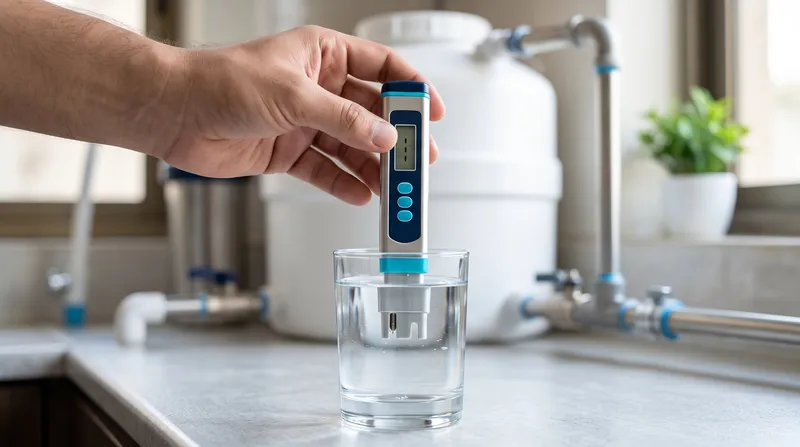
If you've just checked the TDS of water at home with a TDS pen and you're wondering what your number means, this page is for you. We've kept it simple, and every number links to where it comes from.
mg/L or ppm? Same thing for drinking water. A meter showing 250 ppm means 250 mg/L.
TDS chart: what does my reading mean?
Find your reading in the first column. The taste ratings are from the World Health Organization (WHO). The last column compares it with Pakistan's limits: 500 mg/L for bottled water and 1,000 mg/L for drinking water.
| TDS (mg/L) | WHO taste | Pakistan limits |
|---|---|---|
| Below 300 | Excellent | Within both |
| 300–500 | Good | Within both |
| 500–600 | Good | Over bottled limit |
| 600–900 | Fair | Within drinking limit |
| 900–1,000 | Poor | Just within drinking limit |
| 1,000–1,200 | Poor | Over national limit |
| Above 1,200 | Unacceptable | Over national limit |
One thing the chart doesn't show: WHO also says water with extremely low TDS can be unacceptable because of its "flat, insipid taste", and that it's often corrosive to pipes. More on that below.
Sources: WHO, Total dissolved solids in drinking-water; National Standards for Drinking Water Quality, Pakistan (2010); APP, PCRWR on water quality across Pakistan (Sept 2026).
What are Pakistan's official TDS limits?
There are two numbers to remember: 1,000 mg/L for drinking water and 500 mg/L for bottled water.
The drinking water limit comes from the National Standards for Drinking Water Quality, published by the Pakistan Environmental Protection Agency in the Gazette of Pakistan in 2010. The same table sets a few other numbers worth knowing:
| What's measured | Pakistan drinking water standard (2010) |
|---|---|
| Total dissolved solids (TDS) | Below 1,000 mg/L |
| pH | 6.5 to 8.5 |
| Total hardness (as calcium carbonate) | Below 500 mg/L |
| Chloride | Below 250 mg/L |
| Taste and smell | Not objectionable |
For bottled water the limit is tighter. In September 2026 the director of PCRWR's National Water Quality Laboratory told APP that the drinking water standard allows up to 1,000 mg/L, and the bottled water standard is 500 mg/L.
Other countries land in a similar place. Health Canada's target is 500 mg/L or less, and Australia's guidelines say up to 600 mg/L for good taste. Both say these are about taste, not health. Health Canada says a health-based limit for TDS "is not warranted".
Sources: National Standards for Drinking Water Quality, S.R.O. 1063(I)/2010; APP, "Water quality varies sharply across Pakistan: expert"; Health Canada, Total dissolved solids (TDS); Australian Drinking Water Guidelines, TDS.
Is very low TDS water, like 20 or 30, better?
No, not automatically. A low number feels like "pure", but that's not how it works.
The PCRWR laboratory director said readings like 14, 20 or 30 mg/L shouldn't automatically be taken as a sign of better water, especially since RO systems take minerals out. In another interview she said people often think very low TDS means safer water, and "this is not correct".
WHO says extremely low TDS water can taste flat and is often corrosive. Australia's guidelines also say water with very high or very low TDS may be corrosive.
That's why many RO plants add a measured amount of minerals back after the membrane. Our RO remineralisation guide explains how that works.
Sources: APP, "TDS testing pens gain popularity in Islamabad" (Sept 2026); APP, "Ultra-low TDS water may not mean healthier water: PCRWR expert"; WHO, Total dissolved solids in drinking-water; Australian Drinking Water Guidelines, TDS.
What TDS should RO water have after adding minerals?
There's no single official target for RO water. What you do have are the limits above: stay under 500 mg/L if you sell bottled water, and WHO's taste chart says under 600 is good.
It helps to know how much each mineral raises TDS. We worked these out from the chemical formulas. They're approximate, because a TDS meter estimates from conductivity, so your meter may read a bit differently.
| 1 gram added to 1,000 litres of… | Raises TDS by about |
|---|---|
| Calcium chloride (dihydrate) | 0.75 mg/L |
| Magnesium sulphate (heptahydrate) | 0.49 mg/L |
| Sodium bicarbonate | 1.00 mg/L |
For example, adding 10 mg/L of calcium using calcium chloride takes about 37 grams per 1,000 litres, and raises TDS by roughly 28 mg/L (the calcium plus the chloride that comes with it).
Minerals to bring RO water back up
Calcium chloride, magnesium sulphate and sodium bicarbonate from Minerals by Mr. RO, Rs 800 per kg. Same-day delivery in Lahore, 2–3 days by courier across Pakistan.
Can a TDS meter tell me if my water is safe?
No. A TDS meter only gives one number: the total amount of dissolved stuff. It can't tell you what that stuff is.
The PCRWR laboratory director put it clearly: "Even if water has an ideal TDS level of 300 or 500 milligrams per litre, it may still be unsafe." She said TDS pens can't detect arsenic, nitrate, fluoride, heavy metals or germs. They're a rough screening tool, and a lab test is still needed.
So use your meter to spot changes, like a filter or RO membrane that has stopped working. For safety, get the water tested at a lab. Our TDS guide explains what the meter measures and its limits.
Source: APP, "TDS testing pens gain popularity in Islamabad" (Sept 2026).
What if my TDS is too high?
High TDS mostly affects taste and your equipment. Health Canada and Australia's guidelines both say high TDS can cause scale in pipes, heaters and household appliances.
If your reading is above 1,000 mg/L, it's above Pakistan's drinking water standard. Get a lab test to see what's actually in the water. The PCRWR director said RO is useful where water has too much dissolved salt or specific contaminants, but also that people should test their source water before installing one.
TDS also changes a lot from place to place. PCRWR says Islamabad's water is around 300 to 600 mg/L, fresh water in Hunza around 200, and Cholistan around 25,000 to 30,000.
Sources: Health Canada, TDS; Australian Drinking Water Guidelines, TDS; APP, PCRWR expert on RO and TDS; APP, "Water quality varies sharply across Pakistan: expert".
How to get a reliable TDS reading
- Use the same meter when you compare readings. Meters turn conductivity into TDS using different factors (Australia's guidelines mention factors between 0.50 and 0.64), so two meters can show different numbers for the same water.
- Rinse the probe with clean water, and test samples at a similar temperature. Temperature changes the reading.
- Check calibration now and then with a calibration solution.
- Compare before and after your filter or RO. The difference tells you more than one number on its own.
Still choosing a meter? Our TDS meter price guide compares what's on sale in Pakistan and walks through using one step by step.
Not sure what your reading means for your plant?
Send us your TDS reading and plant capacity on WhatsApp, and we’ll tell you which minerals could help.
Frequently asked questions
What is the TDS limit for drinking water in Pakistan?
Below 1,000 mg/L, under Pakistan's National Standards for Drinking Water Quality (2010).
What is the TDS limit for bottled water in Pakistan?
500 mg/L. A PCRWR laboratory director confirmed this in September 2026, alongside the 1,000 mg/L limit for drinking water.
Is 150 TDS water good for drinking?
On taste, yes. WHO rates water under 300 mg/L as excellent, and 150 is well within Pakistan's limits. But TDS alone doesn't show whether water is safe, so get a lab test for that.
Is very low TDS water better?
Not automatically. A PCRWR laboratory director said readings like 14, 20 or 30 mg/L should not be taken as a sign of better water, and WHO says extremely low TDS water can taste flat and be corrosive.
What is the TDS of tap water in Islamabad?
Around 300 to 600 mg/L, according to the PCRWR laboratory director (September 2026).
What is the ideal TDS for drinking water?
For taste, under 300 mg/L is rated excellent by WHO and 300 to 600 mg/L good. Pakistan's limit is 1,000 mg/L for drinking water and 500 mg/L for bottled water. Very low readings, like 20 or 30, aren't automatically better.
What is the TDS of RO water?
Straight out of the membrane it's usually very low, often a few percent of the water that went in. A membrane removing 98% of dissolved salts turns 600 mg/L feed water into about 12 mg/L. Many plants then add minerals back. See how an RO plant works.
How do I check the TDS of my water at home?
With a TDS pen, which costs about Rs 1,500 to Rs 1,800 in Pakistan. Dip it in a clean glass of water, wait for the number to settle and read it. Our TDS meter guide has the full steps.
Sources
- Pakistan Environmental Protection Agency (2010), National Standards for Drinking Water Quality, S.R.O. 1063(I)/2010
- World Health Organization, Total dissolved solids in drinking-water (background document)
- Health Canada, Guidelines for Canadian Drinking Water Quality: Total dissolved solids
- NHMRC, Australian Drinking Water Guidelines: Total dissolved solids
- APP (7 Sept 2026), Water quality varies sharply across Pakistan: expert
- APP (2 Sept 2026), TDS testing pens gain popularity in Islamabad amid water-quality concerns
- APP (13 Sept 2026), Ultra-low TDS water may not mean healthier water: PCRWR expert
Related: What does TDS in water mean? · TDS meter price in Pakistan · RO water remineralisation guide · Our minerals and prices